Out of Darkness: How an Artist’s Menorah Brought Light After the Storm
In the aftermath of Hurricane Helene, Mitchell County ceramicist Gertrude Graham Smith’s light-bearing pieces emerged as beacons of hope and fortitude.

Q+Art is a series featuring the artists of Western North Carolina. Today, we’re talking with Mitchell County ceramicist Gertrude Graham Smith, whose work is featured in our February 2026 exhibition, Liminal Light: Winter’s Vigil.
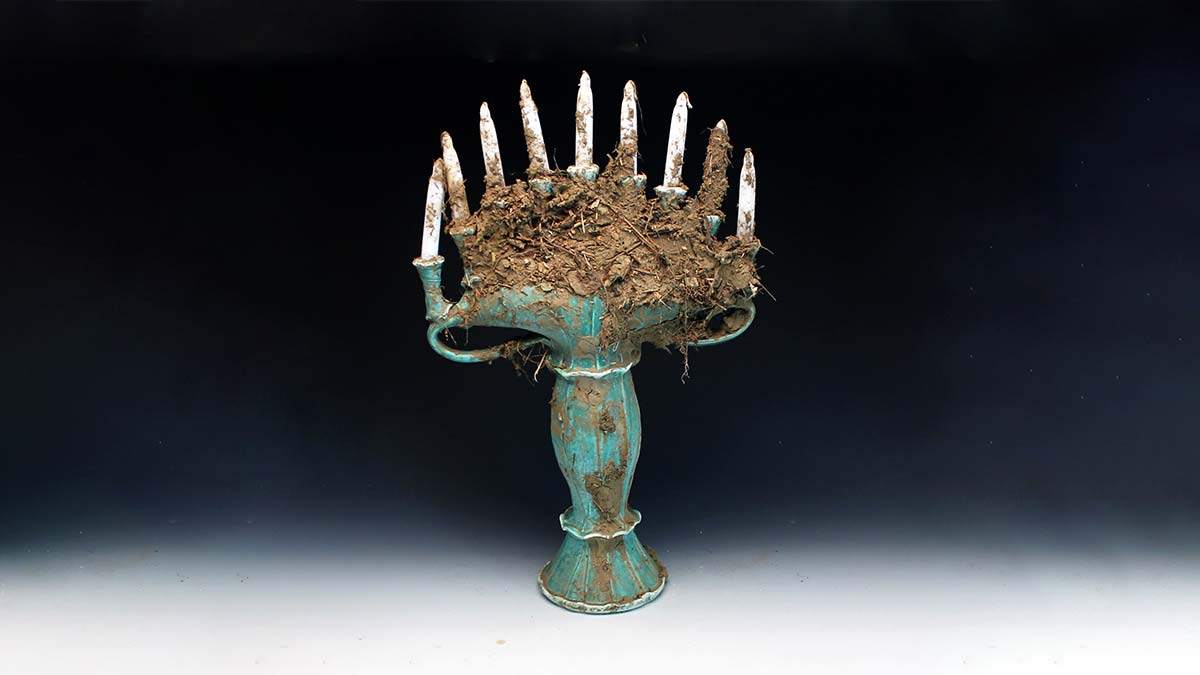
Disaster has a way of turning artists into accidental archivists, even if their chosen medium is as impractical as porcelain. For Mitchell County ceramicist Gertrude Graham Smith, known as Gay to her friends, catastrophe came when Hurricane Helene triggered a mudslide through her kiln shed, an 18-inch deluge that left her gas tank somewhere in Tennessee and her candelabra and menorahs buried up to their necks in sludge. “When I extracted those pieces, I just left them the way I found them,” Gertrude recalls: caked in mud but otherwise unblemished and still standing. “They’re witnesses, or artifacts. They stand for the experience that I went through, and that many of us out here went through.” Miraculously, she lost only one piece from the entire collection.
Gertrude gravitates toward forms that, in her words, “bring light”—candelabra, menorahs, candlesticks—ornate objects that fuse old-world elegance with a pinch of Disney-inspired whimsy, drawing from memories of her grandmother’s lavish table settings and the “truly handmade animated cartoons” of her childhood. Lately, she’s gone “over the top,” creating exuberant, baroque candleholders that seem equally at home illuminating a family Shabbat or frolicking beneath vaulted ceilings in a Beauty and the Beast reboot. “I say they party at night and then put themselves back where they think you won’t know that they’ve been running around all night,” Gertrude jokes. Two such works—"Candelabrum, Amber and Turquoise" and "Dancing Candlesticks, Pair”—featured in our winter craft exhibition, Liminal Light, seem to spiral outward from a central vortex, impish, absolutely full of the dickens, and very likely ready to both serve you custard and light the table while you lick the spoon.
But if her work exudes reverie, its survival is a testament to resilience, both in spirit and in the reconstruction of her soft-brick kiln shed. “It's really important to me to make sure that when I’m in the studio, I’m really enjoying myself. I don’t ever want to just be making things because I feel like I have to,” she says, even as she acknowledges how slowly her creative process has returned since the disaster. Now, as she rebuilds her kiln doors and shares the technical mysteries of soda firing—an atmospheric technique that creates glossy, unpredictable flashes of color, and her specialty for three decades—Gertrude’s candelabra do what they were always meant to do: bear witness and light the way for those who follow.
In Today’s Q+Art Interview…
Gertrude Graham Smith discusses her obsession with creating light-bearing objects, details how one of her mud-covered candelabra found its way into a Ceramic Arts Network documentary, and explores the factors behind the rising popularity of soda-fired ceramics.


On your website, you say you’ve recently been ‘consumed with creating vehicles to spread light in our world.’ Can you tell me why and when you began creating your candelabras, menorahs, and candlesticks?
GGS: I have pretty consistently made candle holders, but never to the extent that I'm making them now. It's kind of over the top at the moment.
It actually started when I lived in Findhorn, Scotland. Findhorn is an eco-village, and when I lived there, it was a non-denominational spiritual community; it still kind of is, but it doesn't necessarily call itself that anymore. When I worked in the pottery studio there, one of the things we made regularly were candle holders with a candle in the middle, and you would surround the candle with flowers. It was like a flower vase kind of combination. We had regular meditation times every day, and whenever we meditated, we lit a candle.
What influences your approach to pottery, and how do you prioritize your time during the creative process?
GGS: I tell my students there are many aspects to making pottery, including different clay consistencies and firing techniques. One way to find your voice is to figure out where you like to spend time. My happy place is to spend time on the wheel. The fact that I've figured out techniques that let me spend more time on the wheel than in other parts of the process has actually determined the nature of my work to a large extent.


One of your mud-covered menorahs is featured in the Ceramic Arts Network's CLAYflix documentary 'Picking Up the Pieces: Resilience and Recovery in the Clay Community After Helene.' Can you share the story behind the documentary?
GGS: [Ceramic Arts Network Senior Editor] Jennifer Poellot Harnetty came up with the idea and got in touch with a bunch of [ceramacists] because she wanted to do something that would help us recover and, hopefully, raise money for the nonprofits that needed help [in Western North Carolina]. She came to the Bakersville area and interviewed me, Nick Joerling, and Daniel Garver.
Jen wanted us to send pictures or videos of the experience we'd had, which, truthfully, was kind of hard. If you were in the middle of it, like I was, with water running down my driveway and me running up the hill to a storage shed with my dog, my duffel bag with water and food, and my computer, there wasn't time to really take videos of what was happening. So I just sent her that picture, and that's how it ended up on the cover of the CLAYflix. They also put it on the cover of their 2025 yearbook.
Editor’s note: Picking Up the Pieces: Resilience and Recovery in the Clay Community After Helene is available to watch here.
Is that particular work still covered with mud?
GGS: I’ve cleaned the others, but not that one. Over time, as the mud dries, bits of it are floating off. I’m curious to see how long it takes before all the dirt drifts off of it since it’s still standing upright.


Why did you personally get interested in soda firing since you've been doing it longer than most?
GGS: I started soda firing in 1993 at Archie Bray Foundation. Their salt kiln was huge and took me days to load. They also had a smaller soda kiln, so I said, "Okay, I'll try it." Nobody had tried it there, but when I saw the results out of that kiln, that was it. I was just hooked. The color response was so brilliant. I’d never seen anything like it. The slips, the glazes, everything was so luscious and gorgeous and bright.
Can you explain how you select your colors using this technique? What factors do you consider to predict the final outcome?
GGS: Part of it is constrained by the type of kiln I have, because I built a kiln here out of soft brick, and most soda, salt, and wood kilns are built out of hard brick, and the hard brick is able to stand up to the destructive, caustic, or alkaline or acidic effects of wood, salt, and soda. So I don't use as much soda in my kiln, but I can still get incredibly brilliant color responses on my clay body and my slips.
I've shifted my focus to color response rather than the directional look you get with wood, salt, and soda.

![[#Beginning of Shooting Data Section]
Image Size:L (7360 x 4912), FX
2017/04/27 08:04:27.10
Time Zone and Date:UTC-5, DST:ON
RAW (14-bit)
Nikon D800
Lens:VR 105mm f/2.8G
Focal Length:105mm
Focus Mode:AF-S
AF-Area Mode:Single
VR:OFF
AF Fine Tune:OFF
Aperture:f/25
Shutter Speed:1/60s
Exposure Mode:Manual
Exposure Comp.:0EV
Exposure Tuning:
Metering:Matrix
ISO Sensitivity:ISO 100
Device:
White Balance:Color Temp. (5000K), 0, G1
Color Space:sRGB
High ISO NR:OFF
Long Exposure NR:OFF
Active D-Lighting:OFF
Image Authentication:
Vignette Control:Normal
Auto Distortion Control:ON
Picture Control:[NL] NEUTRAL
Base:[NL] NEUTRAL
Quick Adjust:-
Sharpening:2
Contrast:0
Brightness:0
Saturation:0
Hue:0
Filter Effects:
Toning:
Optimize Image:
Color Mode:
Tone Comp.:
Hue Adjustment:
Saturation:
Sharpening:
Latitude:
Longitude:
Altitude:
Altitude Reference:
Heading:
UTC:
Map Datum:
[#End of Shooting Data Section]](https://images.storychief.com/account_33748/10smithgg-dinnerware_b0d739e0f8ac166144ccd7683f85b35b_800.jpg)
In an article for ‘Ceramics Monthly,’ you wrote that there's been a recent surge in the popularity of soda-fired ceramics. What do you think is driving the explosion?
GGS: It's hard to say, but I think people who want the effects of flame-firing, as opposed to electric kilns, are drawn to soda firing. The sodium is carried by the flame across the surface of the pots, so you can see exactly where the flames touch the pot. There's a lot of controversy around sodium, but it is said to be significantly less toxic to humans and the environment than salt firing, which is part of the appeal. Wood firing is also incredibly labor-intensive. Potters who want the immediate quality of flame interacting with their glazes can get that effect with much less labor than in a wood kiln.
Editor’s note: Read the article in Ceramics Monthly here.
Are your pieces actually functional or mostly decorative? Where do you draw the line?
GGS: Even though they look delicate, they’re totally functional. They’re strong. You can put them in your dish rack. You can put them in your dishwasher. Most of them you can put in your microwave.
Because I love the wheel and it's traditionally used for functional work, there's something in that limitation that helps me make good work. If I stepped outside the limitations of function, I’m not sure my work would be as strong. There are only so many forms that work for a mug or a cup. You're constrained, but for me, that constraint feels like freedom.


Follow Gertrude Graham Smith
View ‘Liminal Light: Winter’s Vigil’
This interview has been edited for length and clarity. All photos published with permission of the Gertrude Graham Smith; featured image: ‘Flood Survivor Menorah.’