Go Yonder! A Guide to Western North Carolina’s Public Art and Outdoor Sculpture
From glass ‘telescopes' to metal wildflowers, explore the region’s outdoor art scene with this companion guide to our summer exhibition, ‘Open // Air.’

In Western North Carolina, summer brings black bears nosing through berry thickets (and trash cans), neotropical warblers flitting through high-elevation balds, and scattered afternoon thunderstorms that roll through the Blue Ridge Mountains, feeding its famous cascades. While most Southern sidewalks could sear an egg faster than a frying pan in the dead of summer, the mountains keep their cool well into the season’s dog days.
In short, it’s the perfect time to unplug, break out the SPF, and take a self-guided tour of WNC’s many outdoor sculpture parks, public art trails, and garden installations, all with a little help from ArtsvilleUSA’s handy travelogue.
 Morgan Laurens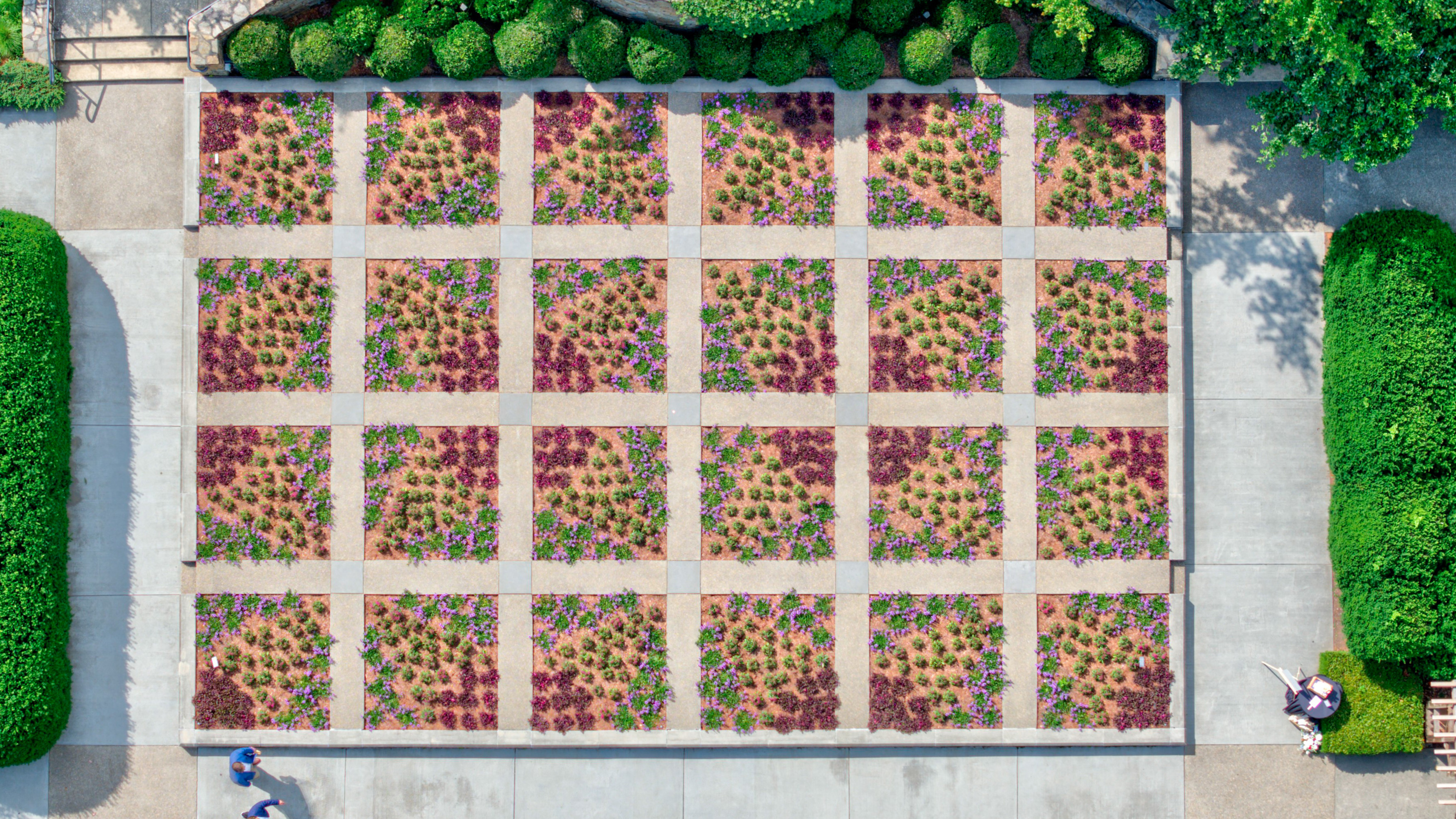
This guide, a companion to our summer virtual exhibition Open // Air, traces public artworks by featured artists across the region. Published in partnership with the Blue Ridge National Heritage Area—a nonprofit dedicated to preserving and promoting the natural and cultural heritage of 25 Western North Carolina counties and the Qualla Boundary—many of the sites are also designated stops on the Blue Ridge Craft Trails, a curated network celebrating the area’s tradition of fine arts and crafts.
Use this itinerary to experience Open // Air up close, now officially part of the Blue Ridge Craft Trails itinerary, thanks to our collaboration with the Blue Ridge National Heritage Area. We hope it inspires you to step outside, whether to Grovewood Gallery’s shady sculpture garden, Burnsville’s stately town square, or the NC Arboretum’s lush Forest Meadow.
North (Yancey, Mitchell, Avery, and Madison Counties)
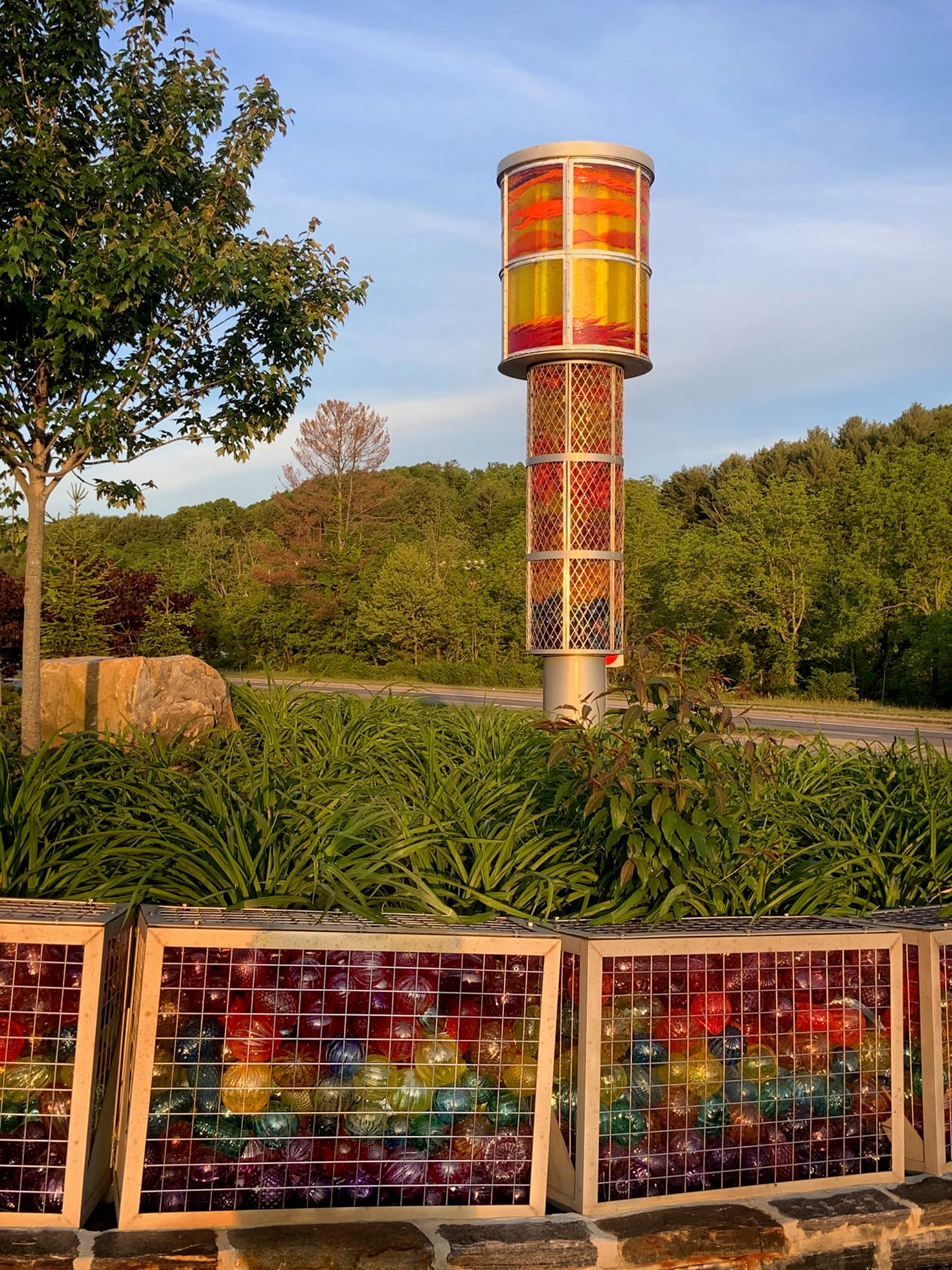
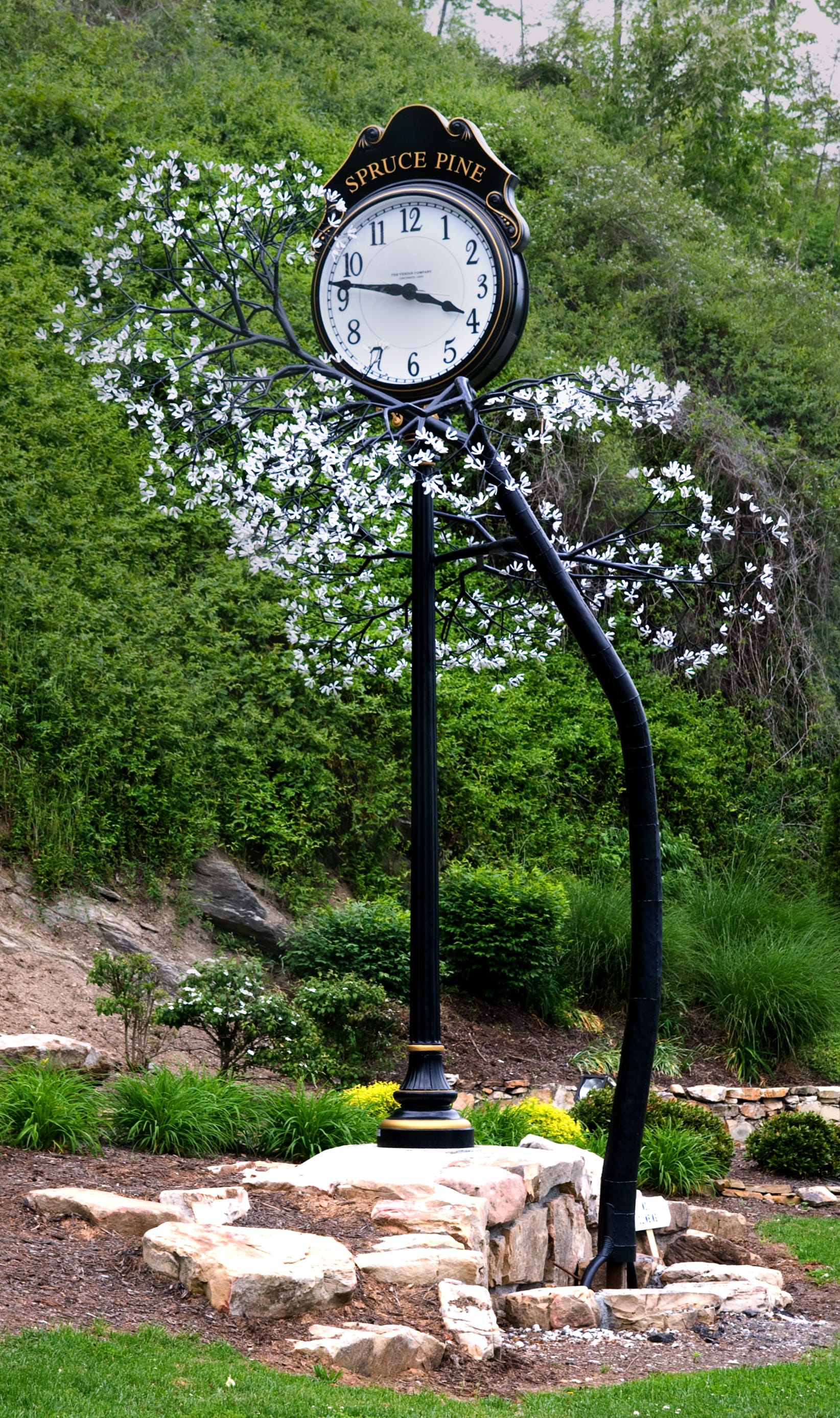
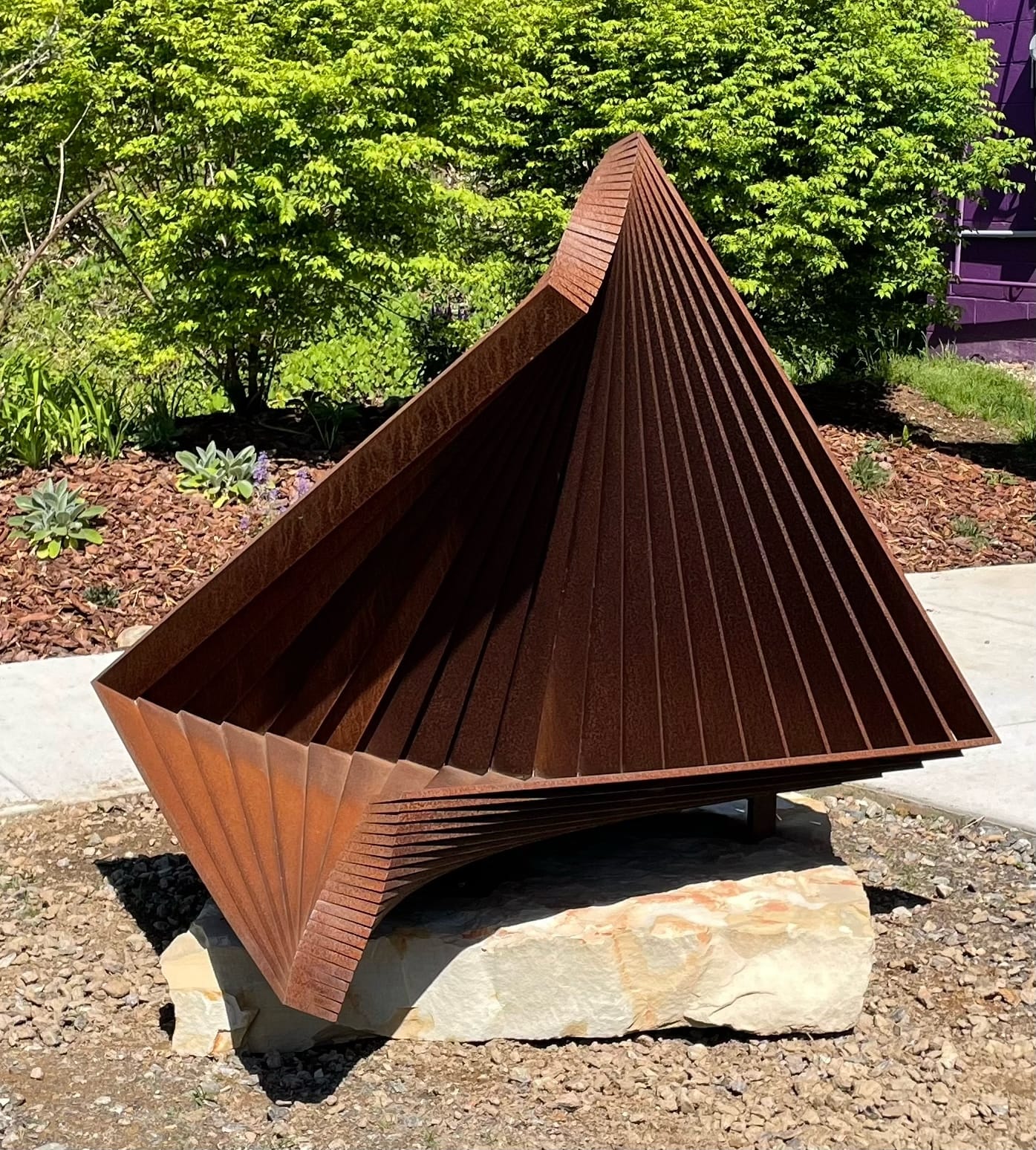
(l-r) ‘Burnsville Gateway’ by Jack Mackie; ‘Sarviceberry Tree’ by Elizabeth Brim; ‘Without Reservation’ by Robert Winkler
Downtown Burnsville
Begin at the Burnsville Gateway, where a towering glass “telescope” stands at the west entrance along scenic Highway 19E. Conceived by Jack Mackie with Toe River Arts and the town, and featuring contributions from exhibiting artists Rob Levin and Elizabeth Brim, this project honors Burnsville’s maritime namesake, Captain Otway Burns, and celebrates the area’s glassmaking tradition.
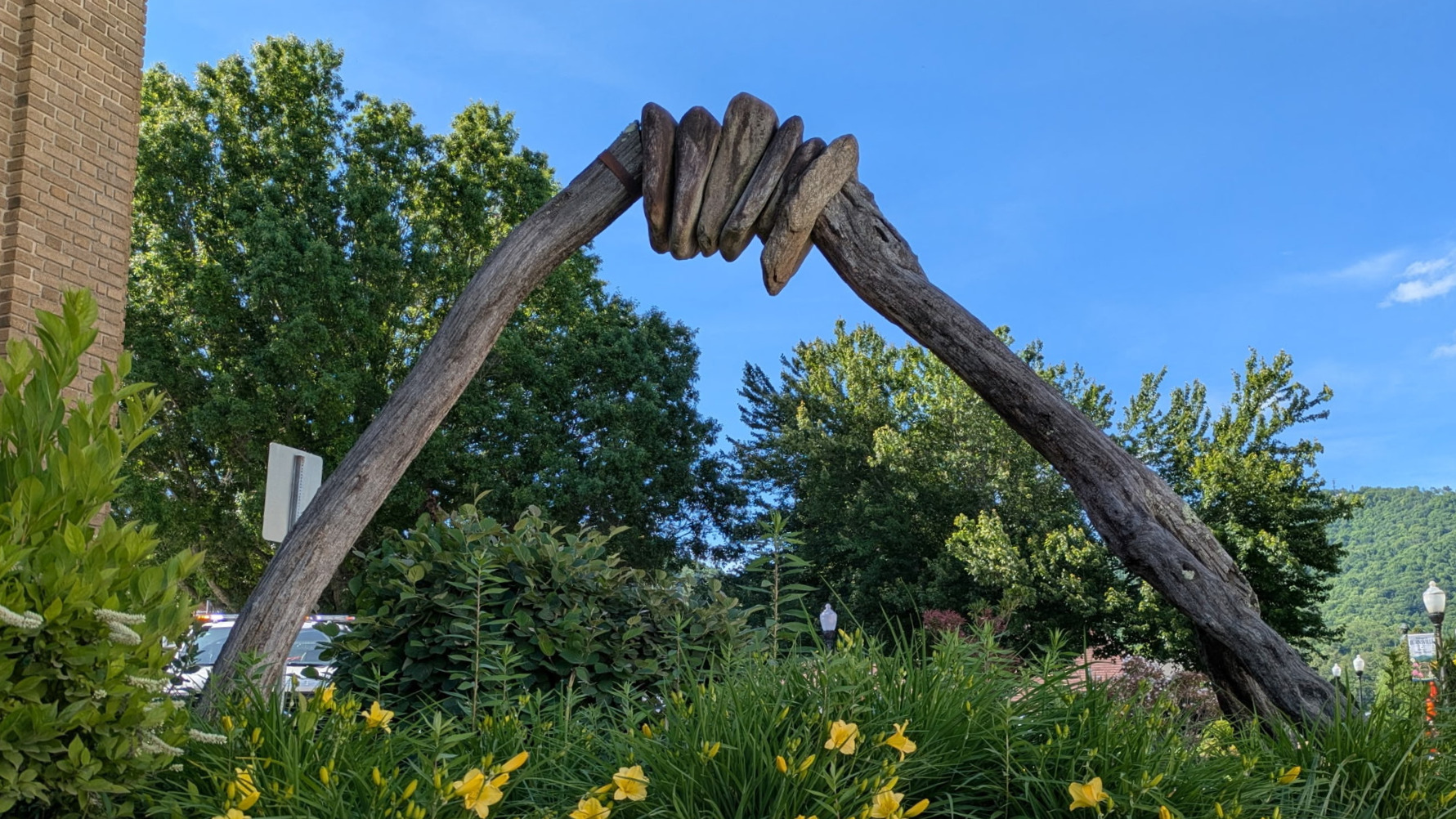
Downtown, look for Elizabeth Brim’s botanical metalwork on Main Street traffic poles—an extension of the Gateway project. In the Town Square, Rob Levin’s beloved “Rock Bridge” echoes the sloping contours of the surrounding mountains. Continue along South Main to find Carl Peverall’s stone sculpture “Anne-Marie,” the first artwork installed along the Toe Valley Trail. Before heading east to Spruce Pine, make a quick detour southeast to Levin Glass in Celo, where you can watch Rob Levin at work and browse his finished pieces in the gallery.
Downtown Spruce Pine
From Celo, drive 20 minutes east to downtown Spruce Pine. At the corner of Roan Road and Oak Avenue, you’ll find Elizabeth Brim’s “Sarviceberry Tree” wrapped around the town clock, a steel sculpture that appears to bloom year-round. Forged in 2008, its white blossoms were hammered by Elizabeth with help from fellow blacksmiths and festivalgoers at the Fire on the Mountain blacksmithing festival.
The serviceberry—“sarviceberry” in local parlance—is one of the region’s first spring bloomers. Elizabeth installed the piece a year after arson destroyed several buildings downtown, choosing the tree as a symbol of renewal. Today, her “Sarviceberry Tree” is both a well-recognized landmark and an emblem of Spruce Pine’s resilience.
Anvil Studio Sculpture Garden
Continue your journey east from Spruce Pine for about 15 minutes and arrive at the Anvil Arts Sculpture Garden & Gallery in Linville Falls, Avery County. Founded in 1981 by sculptor Bill Brown, this destination brings together an impressive collection of outdoor and indoor works by Bill, his son Gamble, and a roster of regional artists, including exhibiting artists Josh Coté and the father-son duo Ethan and Carl Peverall.
Stroll the expansive sculpture garden to discover large-scale works in metal, glass, clay, and stone set amid mountain scenery. The grounds are dotted with forged and fabricated works, while the indoor gallery offers a curated selection of paintings, drawings, and smaller sculptures. Walk-ins are welcome, or you can schedule a private appointment for a more personal experience.
Mars Landing Galleries
Loop back west on Hwy 19E to Mars Hill, where Open // Air artist Robert Winkler’s steel sculpture “Without Reservation” marks the entrance to Mars Landing Galleries.
Robert’s sculpture explores movement, balance, and shifting perspective. Walk around it and watch the lines fracture and reassemble as shadows reshape the piece from every angle. The sweeping, abstract shapes—neither strictly geometric nor organic—invite viewers to rediscover the work with every step.
“Without Reservation” echoes Robert’s broader constellation of public works across the Southeast. In his sculptures, negative space is as vital as steel, and changing daylight becomes an unpredictable collaborator. The outdoor setting animates the work, bringing it to life with shifting light and weather. Stop by the Mars Landing Galleries at any hour to see how the sculpture transforms with the day’s light.
Central (Buncombe County)
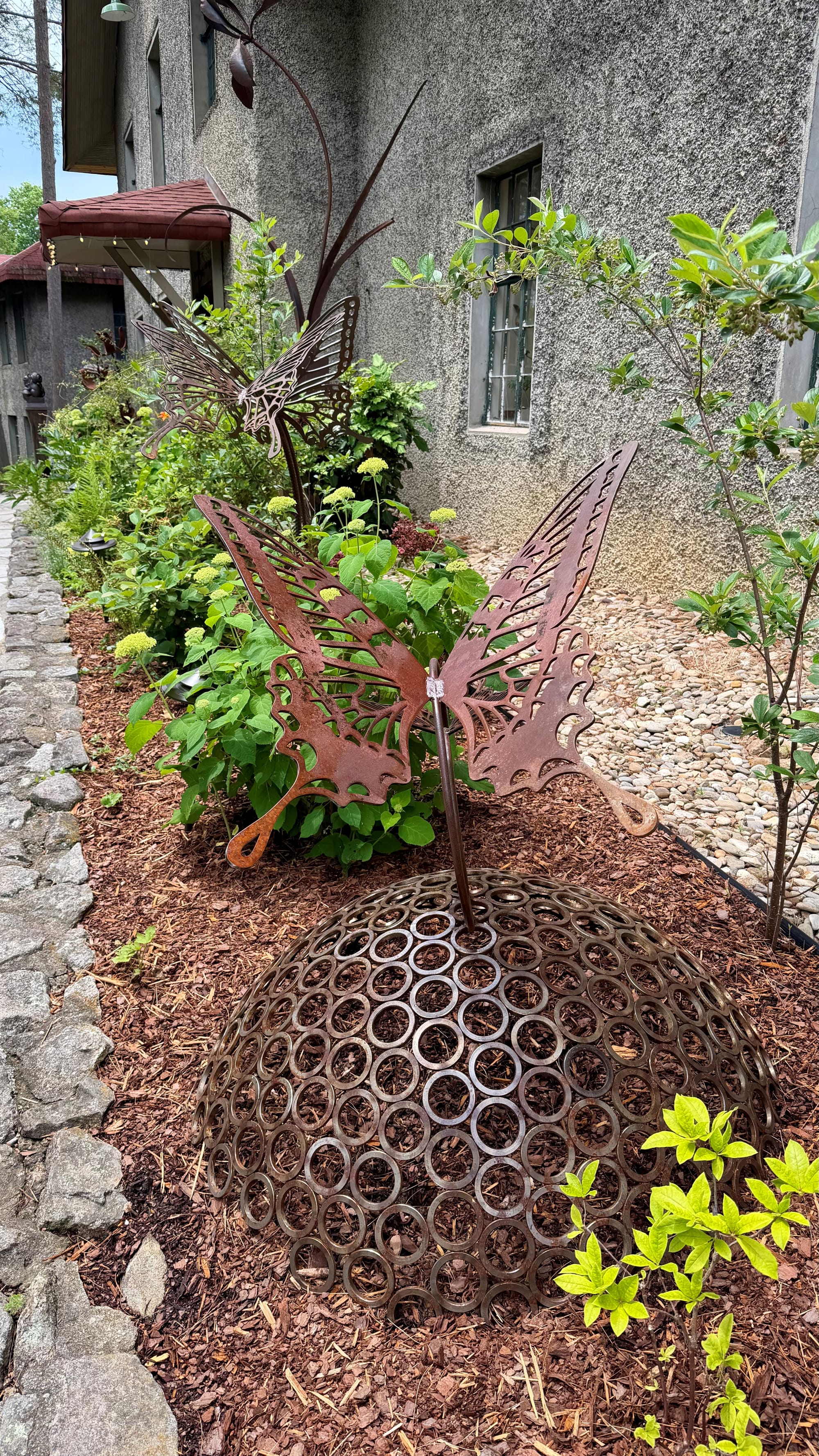
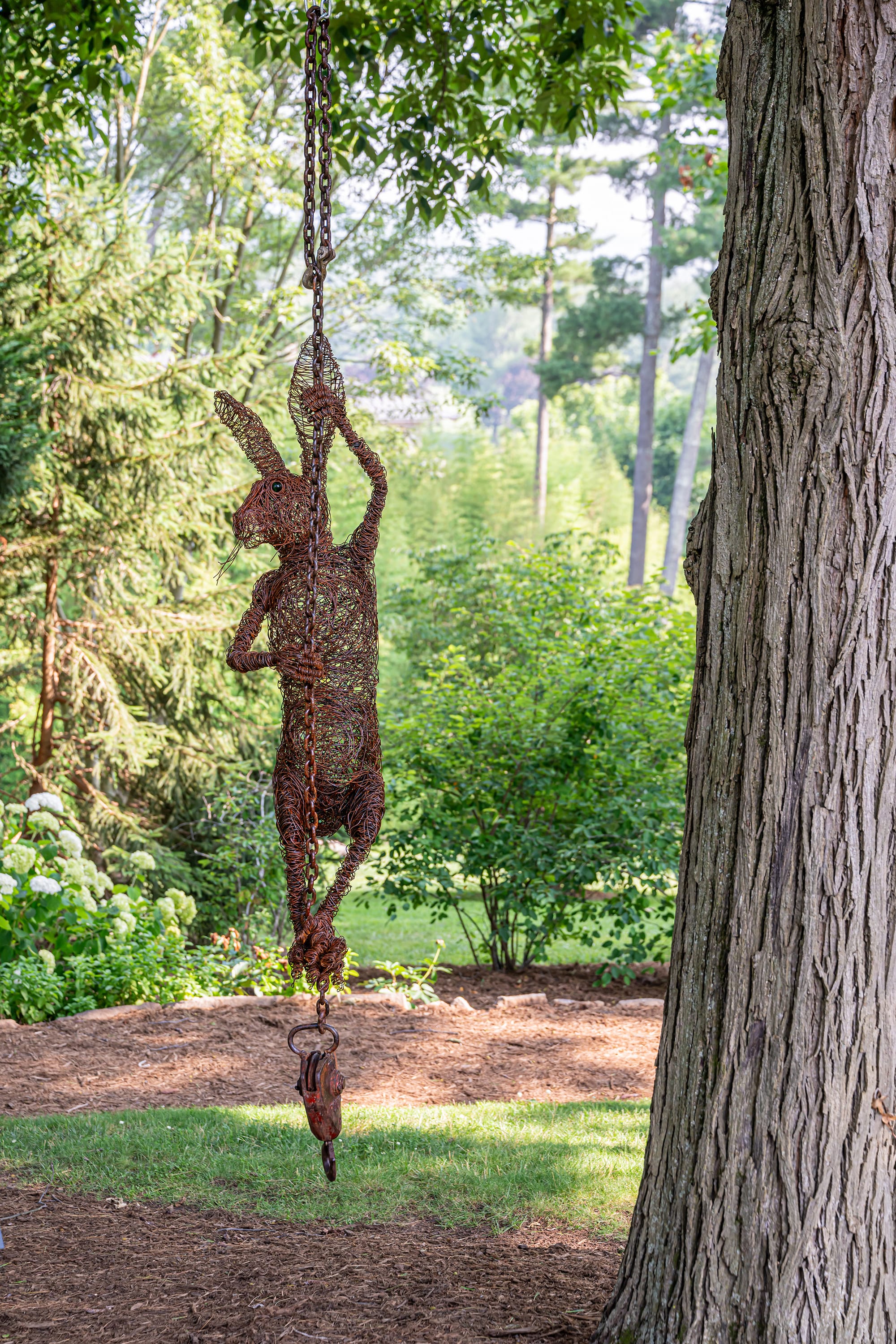
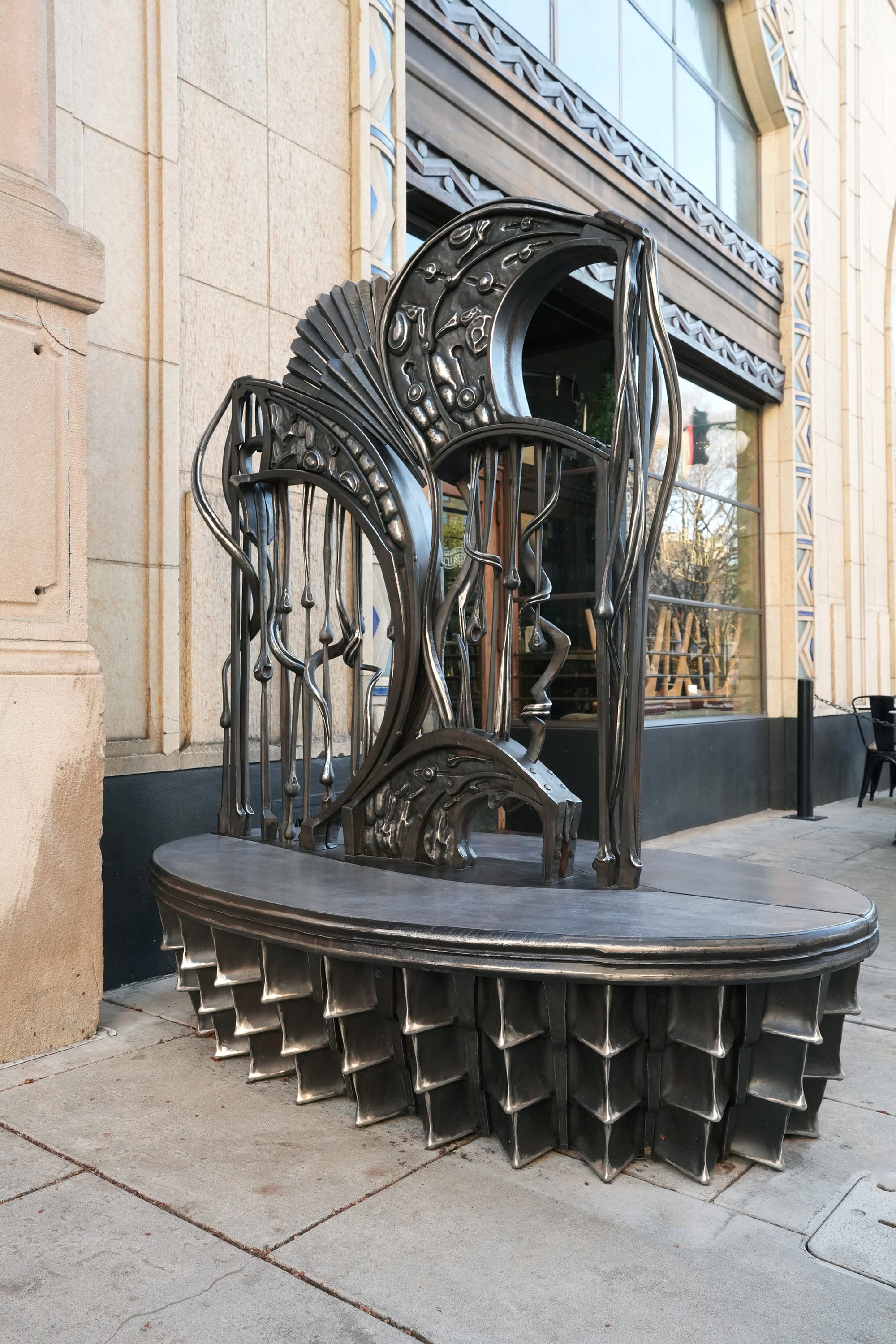
(l-r) ‘Reunion’ by Todd Frahm; ‘Wild Hare’ by Josh Coté; ‘Fluvial’ by Rachel David
Grovewood Gallery
A short drive south of Mars Hill brings you to Grovewood Gallery Sculpture Garden, beside Asheville’s historic Omni Grove Park Inn. Part of Grovewood Village—a cluster of artist studios, museums, and galleries—the garden is a perennial favorite for art lovers, history buffs, families, and anyone seeking a scenic spot to stroll or picnic.
Wander the meandering, ivy-bordered paths, and you’ll spot four new works by Asheville artist Todd Frahm, known for large-scale animal sculptures. Inside, Josh Coté displays a “Wild Hare,” a dangling, life-sized rabbit crafted from miles of hand-bent wire. A self-taught sculptor, Josh transforms humble materials into figures reminiscent of pen-and-ink drawings rendered in three dimensions, often incorporating antiques.
Although Josh’s work isn’t currently on view outdoors, his hares are perennial favorites. Don’t miss the chance to see them up close or browse for smaller pieces inside the gallery.
Downtown Asheville
From Grovewood Gallery, it’s a quick drive to the Asheville Urban Trail, a free, self-guided walking tour that starts at Pack Square and winds through downtown Asheville. At Station 7, in front of the historic S&W Building on Patton Avenue, find Rachel David’s “Fluvial,” a water-inspired metalwork featured in Open // Air. Situated beside The Times Bar & Coffee, this sculpture reflects Rachel’s fascination with the landscapes and habitats shaped by flowing water.
While downtown, make your way to the Asheville Art Museum. On the rooftop sculpture terrace, you’ll find Dale McEntire’s “Night Lotus,” a striking combination of black steatite and steel. Created in 2014 and gifted to the museum in 2020, “Night Lotus” offers a quiet moment of reflection high above the city streets. Museum tickets are available online or via a free Zoom pass offered to Buncombe County residents by the Buncombe County Public Library.
NC Arborertum
Fifteen minutes south of downtown, the North Carolina Arboretum offers 65 acres of cultivated gardens, rotating outdoor exhibitions, and permanent installations. Begin your visit in the Formal Gardens, where curator Julie Guy oversees the evolving Quilt Garden featured in Open // Air. Redesigned every two years, this meticulously planted display draws on historic quilt patterns shaped by Scottish, Irish, German, Native American, Amish, and Quaker traditions. Each pattern tells a story, weaving together the region’s diverse influences and the earthy color palettes of Appalachian quilts.
The Quilt Garden also reflects the longstanding Appalachian tradition of quilting as both craft and community. For generations, quilting bees united neighbors, passing down skills and stories through shared labor and conversation.
Continue to the Forest Meadow, where Grace Cathey’s "Life of the Monarch" celebrates the butterfly’s life cycle in a colorful kaleidoscope of metal. Featured in Open // Air, the sculpture is surrounded by native plantings and interpretive signs about pollinators.
West (Haywood County)
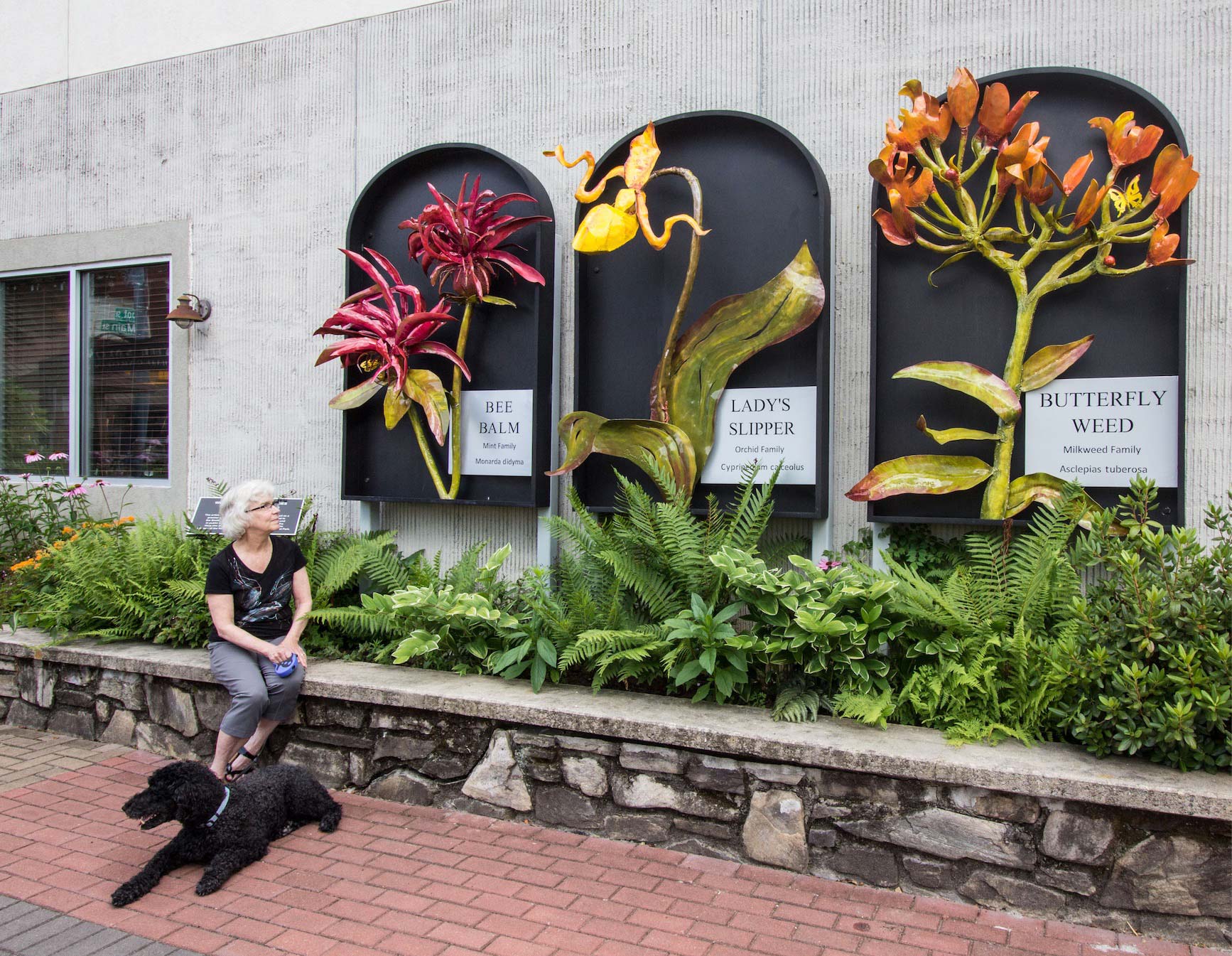
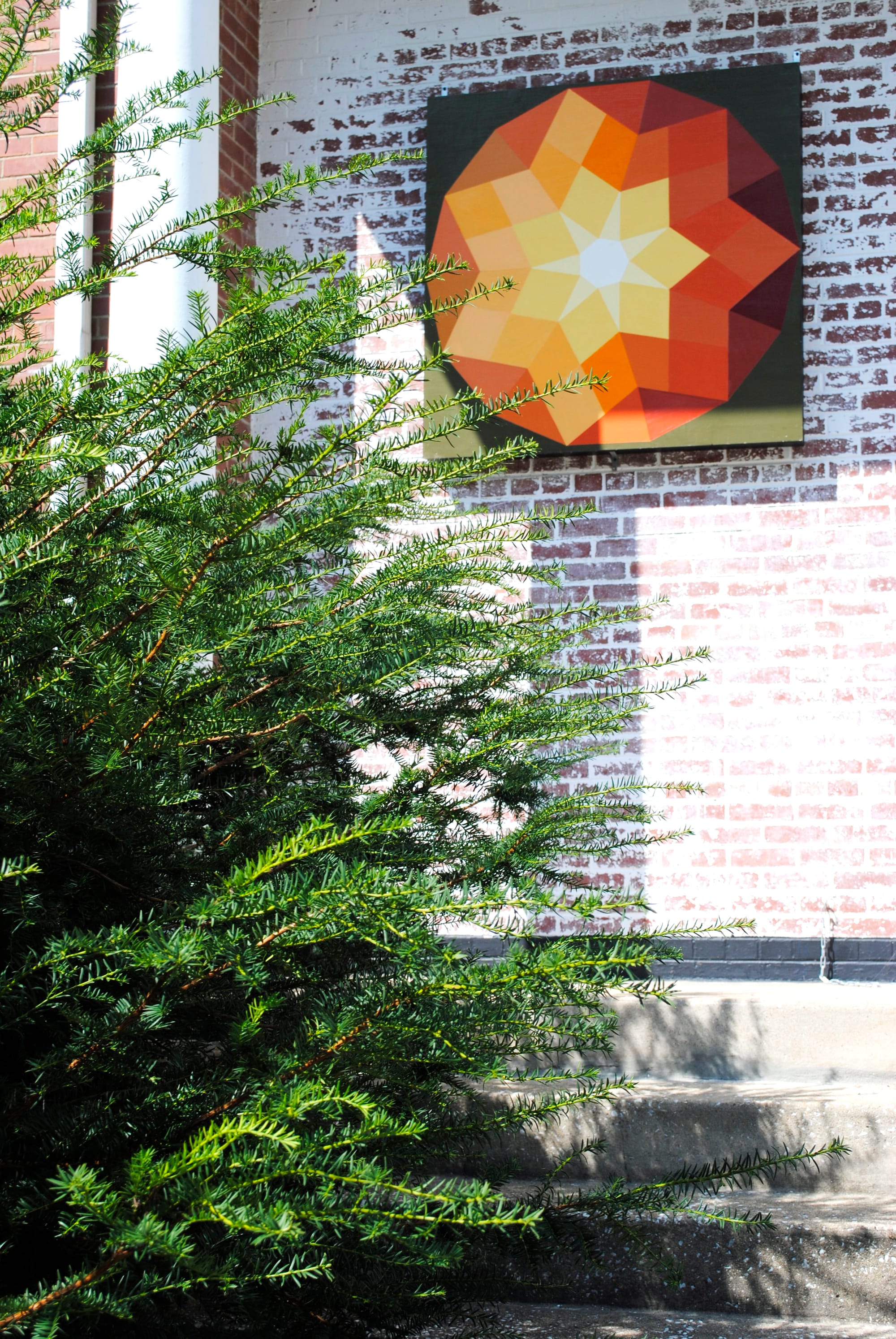
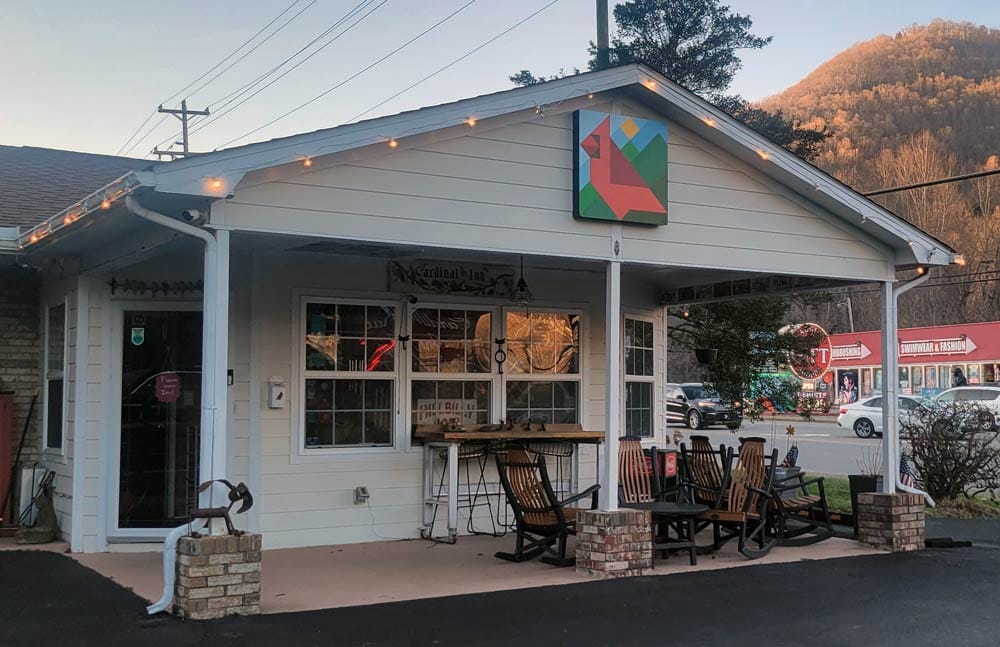
(l-r) ‘Wildflowers of the Smokies’ by Grace Cathey; Folkmoot Friendship Center quilt square; Cardinal Inn quilt square
Downtown Waynesville
Start your self-guided exploration of the Waynesville Public Art Trail by following I-40 into town. First stop: 455 Hazelwood Avenue, home to Todd Frahm’s bronze Plott Hound. Installed in 2017, this tribute to North Carolina’s official state dog commemorates the breed’s deep roots in the region, a legacy shaped by the Plott family, who brought their hounds from Germany in the early 1800s.
Next, head downtown to 16 S. Main Street, where exhibiting artist Grace Cathey’s whimsical steel sculpture, “Bear in Mind: It’s Feeding Time,” greets visitors outside town hall. Continue up Main Street to 171 N. Main, where Cathey’s “Foxy” keeps watch, inspired by her sister’s mysteriously disappearing chickens.
Finish at 185 N. Main, where Cathey’s “Wildflowers of the Smokies”—a trio of native steel flowers featured in Open // Air—celebrates the region’s biodiversity and botanical heritage, echoing the spirit of early explorers who first cataloged the Smokies’ natural wonders.
Haywood County Quilt Trail
Travel west from Asheville into Haywood County, where the Quilt Trails flourish under the guidance of arts council director Tonya Harwood. This public art project features more than 300 hand-painted quilt squares mounted on barns, businesses, and homes across nine mountain counties.
Begin at the Quilt Block Studio, inside Waynesville’s Folkmoot Friendship Center, where volunteers craft new blocks by hand. Pick up a brochure and map—also available at the Visit Haywood Welcome Center and Haywood Handmade Gallery—to plan your route through five distinct quilt trails, each meandering through rolling farmland and charming small towns.
Along the way, look for quilt designs that honor local people and places. Since 2008, the quilt trails have become a regional tradition, maintained by dedicated volunteers and inviting travelers to slow down, look closer, and connect with Western North Carolina’s heritage.
All photos published with permission of the artist(s); featured artwork: “Rock Bridge” by Rob Levin. Photo: Michael Graf.